
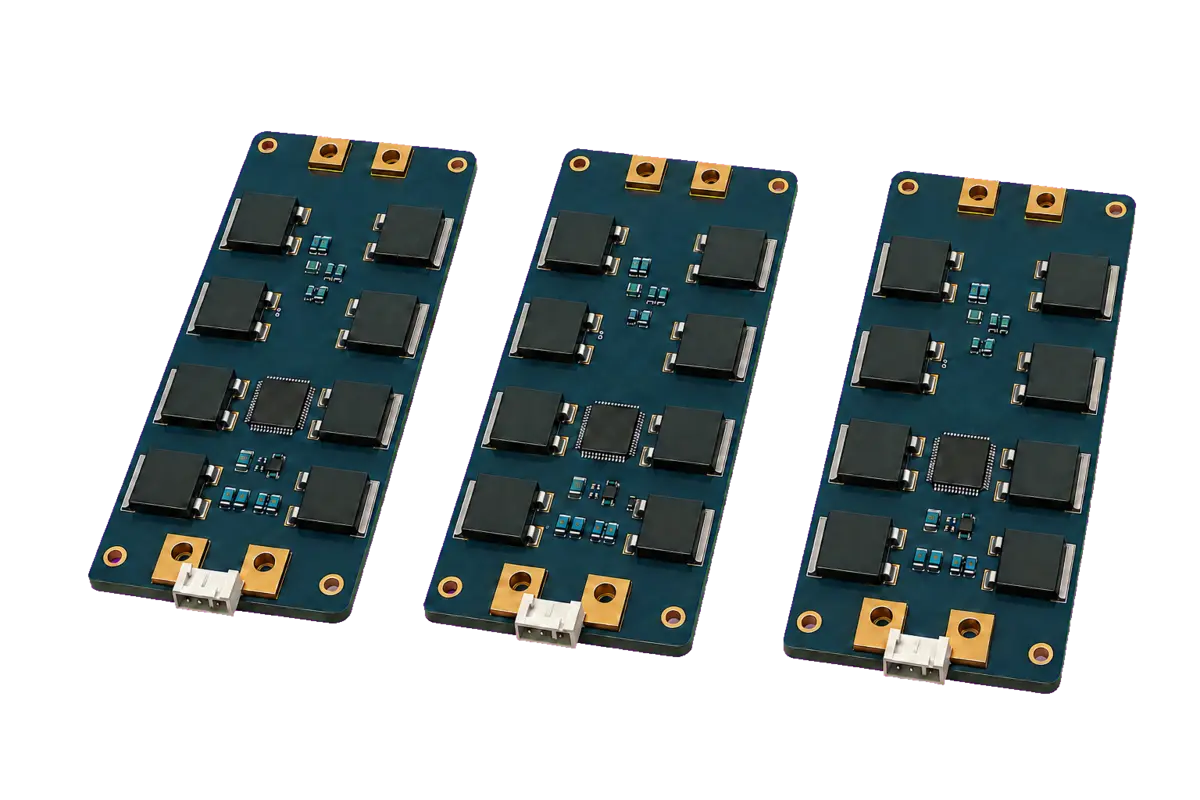
To improve battery life span and reliability we’ve developed NuBaCell, a distributed battery architecture with adaptive load-balancing, based on granular, cell-level control. The new technology relies on cell switching to enable truly reconfigurable, scalable battery designs. Nubacell can make use of inexpensive, mass-market battery cells and still demonstrate an impressive battery life span. Cell degradation and failures normally reduce the autonomy (range) of our batteries, without affecting their electrical output or operational stability.
Here are the key aspects of our technology:
Significantly longer battery life
Nubacell adaptive load balancing helps equalise the capacity and health status across battery cells and protect them from premature cell aging. This can significantly prolong the operational life span of Nubacell batteries over today’s traditional multicell designs.
Cell-level intelligence and control
The Nubacell batteries rely on the managed (switched) cell modules. The modules provide intelligence on the State of Charge (SoC), State of Health (SoH) and State of Failures (SoF) of the hosted cells and can be switched on and off by the BMS controller to distribute and attenuate the load across present cells.
Modular scalability
Cell module is also a unified building block for various-scale battery designs. To simplify system design and serviceability, architects can group two or more parallel cells per module, and several modules can be grouped into removable arrays. Moreover, adding extra cell modules and arrays does not result in increased battery voltage. By the same token, removing cell modules would not impact battery operation unless the remaining cells were too few to support the required voltage and load current.
Stepwise regulation and stabilisation of battery voltage
Nubacell batteries can support different output voltages. The voltage is regulated by changing the number of active, concurrently loaded cells. Also, battery voltage is automatically stabilized through the entire discharging cycle; more cells can be activated to compensate for the decline in individual cell voltage or a sharp increase in load current.
Serviceability and upgradeability by design
Batteries can be designed to let users in the field replace faulty elements and expand battery capacity on their own. Granular health information and cell indication can help proactively designate compromised elements for replacement. The existing battery capacity could be expanded with additionally purchased cell modules, without having to pay for a whole new battery.
Fault tolerance and longer uptime
The switched cell architecture and the elimination of accelerated cell ageing ensure Nubacell's higher fault-tolerance. Furthermore, activated cells compensate for voltage deficits until faulty cells are replaced. Plus, the battery enclosure can support “hot” swapping of cell modules, without disrupting working battery operation or output voltage.
Support for heterogeneous cell configurations
To cater to different applications and use cases The Nubacell battery architecture can support various cell form-factors and chemistry types. It can also control mixed cell chemistry configurations, for instance a combination of LFP and LiPo cells, to offer both high-current power bursts for car acceleration and the lower sustained power required for long distance travel at the same speed.