Connected
The cell participates in the main current path and contributes to the battery’s output.

Technology
Nubacell is a reconfigurable battery architecture built around individual cell control. It allows the battery to change how its cells are used during operation instead of relying on one fixed electrical configuration.
01 / Architecture
Each battery element (a cell or a group of cells) is paired with dedicated monitoring and control electronics. Nubacell adds two electronic switches to each element: one connects it to the battery’s main current path, while the other bypasses it.
The cell participates in the main current path and contributes to the battery’s output.
Current is routed around the cell, so it does not contribute to the output.
The controller can move cells repeatedly between these states during normal operation.
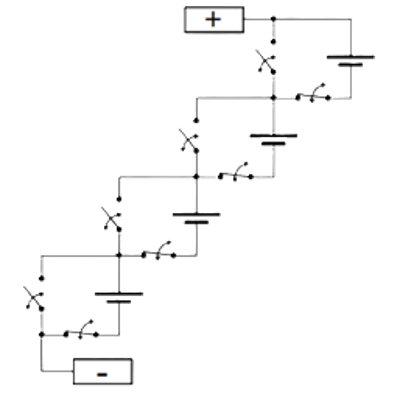
Two electronic switches for each battery element
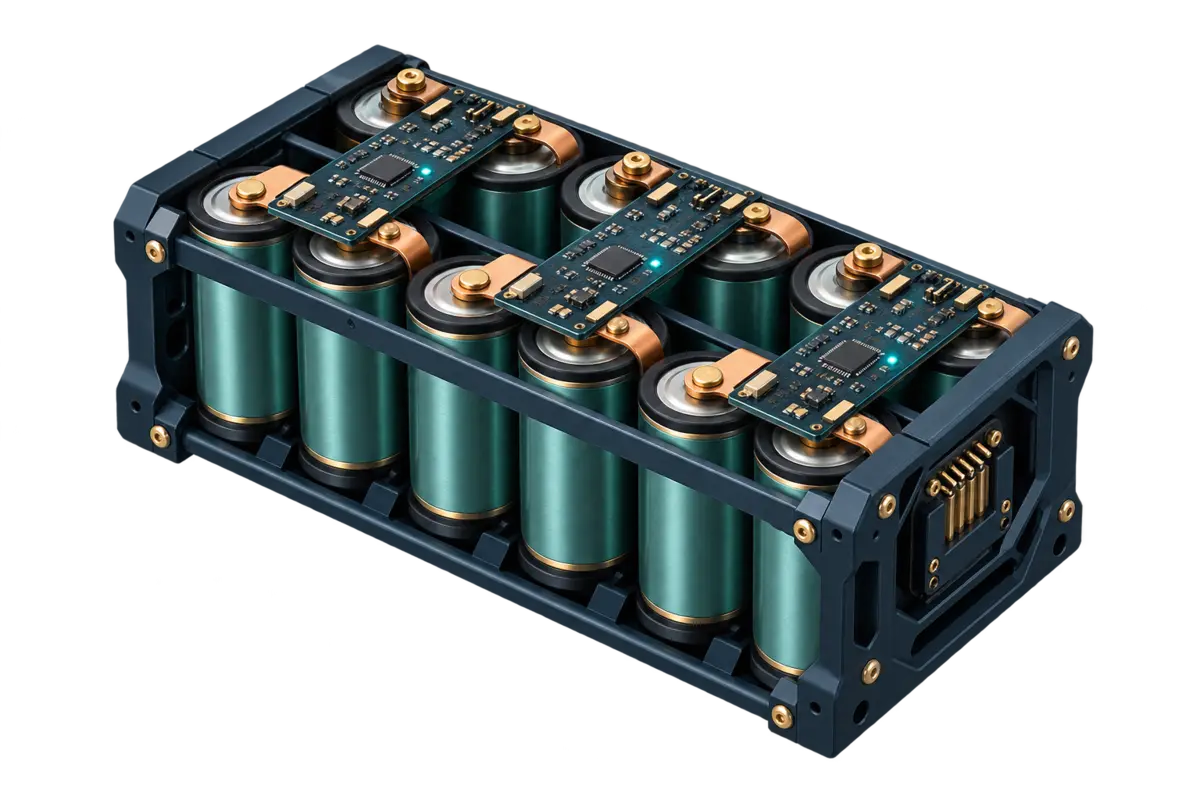
Distributed control boards installed directly on the battery elements
02 / Control
The control system continuously evaluates the condition of every cell and the battery’s current operating requirements.
Available capacity, state of charge, state of health, required voltage and load conditions are used to select an optimised set of connected cells. During normal operation, this selection is typically updated every few seconds.
Stronger cells can remain connected for longer, while weaker cells spend more time bypassed. This balances how the cells are used rather than requiring every cell to contribute equally.
03 / Battery management
Nubacell is not an additional system installed alongside a conventional BMS. It replaces the conventional BMS architecture with a distributed platform that combines battery management, protection, cell-level monitoring, individual switching and dynamic reconfiguration.
A conventional BMS monitors and protects cells and may balance their charge. Nubacell also controls whether each cell participates in the battery’s main current path.
This changes the principle of battery management: cell usage is balanced by controlling participation rather than only by adjusting differences in cell charge.
04 / Capabilities
Differences between cells increase as a battery ages. By adapting cell participation to their individual condition, Nubacell reduces the extent to which the weakest cell limits the whole battery and allows more of the available capacity to be used.
This can extend useful battery life, depending on cell chemistry, duty cycle and system design.
The output voltage is controlled by changing the number of connected cells.
Within the system’s designed operating range, the target voltage can be configured and adjusted in software without rebuilding the physical battery.
If a cell reaches an operating limit or develops a fault, it can be bypassed and a new set of connected cells selected.
The battery can continue operating provided the remaining cells can supply the required voltage and power, with a corresponding reduction in available capacity.
Individual cell control and condition data allow battery systems to be designed for selective cell or module replacement, refurbishment and capacity expansion.
This can reduce unnecessary replacement of healthy battery hardware and simplify service over the system lifetime.
Real-time condition data from every cell provides full battery visibility and supports predictive maintenance.
The architecture can accommodate aged and second-life cells within defined electrical and safety limits, unlocking additional value from existing battery assets.
Cells of different capacities, ages and manufacturers can operate in the same system without strict matching requirements.
The architecture can also be integrated with supercapacitors.
05 / Demonstrator
Evaluate Nubacell technology under real operating conditions, including:
A battery should use the available capacity of every cell—not be limited by the weakest one.
What we offer